May 17, 2011

Pit Stop Chengdu - Travel Fatigue


The ten hour bus ride from Litang to Kangding was very uncomfortable. The roads were rough and bumpy as we crossed over several passes well above 4,000 meters. The worst part were the surprise pot holes that lifted me off the seat and slammed me back onto my rear thus aggravating an already sore lower back. I began feeling a bit nauseous towards the end of the journey as we topped the last pass through thick fog and snow.

By time I arrived in Kangding I was feeling totally exhausted. Bus rides, foreign culture, cigarette smoke, unfamiliar places, nasty Chinese toilets, language difficulties, odd food, etc., etc., were all taking its toll. I call it cultural travel fatigue. Anyone who ventures within a foreign country for an extended length of time is bound to have a case of it. The cure? Go someplace for a few days that’s clean and comfortable, find a good place to stay, hang out with other westerners, and eat whatever western food you can. Also, plan to do nothing and avoid busses and public transportation. In 3 to 4 days you should be ready to go again.

Although I was feeling totally exhausted I boarded another bus the following day (yesterday) for Chengdu. When I arrived at the station to buy my ticket there was no one in line. The lady at the counter had minus zero patience and immediately grew quite angry with me as I fumbled through my phrase book to make sure I got on a bus with a toilet. I had been a little sick the night before so I wasn’t sure how I was going to do on the bus ride.

The whole ticket buying process probably took around 3 minutes and by time I left I think the lady was about to blow a gasket. As one traveler put it, “When you arrive in Kangding you will know your back in China”. I’d been spending quite a bit of time in Tibetan regions which are very different from the Han regions. Han Chinese make up the vast majority of Chinese culture.

It cost me 10 Yuan more to be on a nicer bus with a toilet. Also, I was shocked and overwhelmed with joy to see that the bus was non smoking. The driver still smoked but everyone else abided by the non smoking rule which was a miracle. In China I think just about every male smokes and does it as they please. The cigarettes they smoke are cheap and disgusting with second hand smoke that literally makes a non smoker want to puke. What’s really interesting though is that I have not seen one single woman smoke. I predict someday women will take over China as all of the men will die young and impotent.

The bus ride to Chengdu was nice and smooth. Aside of a short section of construction the roads were paved. Partway through the ride a nice young Chinese man sat next to me wanting to practice his English. The only drawback was his bad breath but I was able to find out what bus station I’d arrive at so I could accurately decipher my Lost Planet (Lonely Planet) guidebook.

As we rounded into the Bus Station at Chengdu I noticed a tourist information center like you might see in Europe. This is a rarity in China and the first one I’ve seen. Instead of roaming around the city looking for the right accommodation I decided to inquire first. I was happy to find a nice pleasant Chinese woman there who spoke some English. She happily made a couple of calls for me and in the end recommended a hotel right around the corner from the Bus Station. She said it was good and many foreigners stayed there.

I checked into a simple spotlessly clean single with air con and shared bathroom across the hall. The bathroom is super clean and on par with the finest western standards. All for the price 80 Yuan per night which converts to around $12.25. It’s very comfortable and I like it a lot. Right behind the hotel is a hostel that caters to westerners and has a cafĂ© with a good variety of western food at backpacker prices. There’s also a pleasant common area for travelers to chill and hangout. So, I’ve got the comfort and quality of a nice hotel with the benefits of a backpacker hostel all in one. Perfect! Just what I need right now.

As for Chengdu it’s a world away from where I’ve been and I haven’t really been in city since Kunming. Chengdu represents the new China. Lots of well educated young professionals, modern conveniences, clean streets and sidewalks, etc. etc… Despite being the 5th largest city in China it seems pretty relaxed and has a good feel. I originally planned to skirt around Chengdu but right now I’m happy to spend 3 or 4 days here.

May 14, 2011

Litang - Western Sichuan, China


Litang is a rough and dirty Tibetan town full of character and the friendliest people I’ve met in China. It took me a day and a half to get here via buses over rough moutain passes but the roads were better than expected. I spent a night in Xiancheng along the way. The scenery has been high and spectacular. Litang is over 12,000 feet in elevation. Western Sichuan is wild country.

Aside of the hacking, spitting, and smoking, not to mention the dust, the bus trip to get to Litang was good. I thought I might be the only westerner on the bus but there were a few others. I met one German, one Dutch, and three Israelis on the ride over. All of us seeking a less touristy more authentic China experience.

There’s nothing touristy about Litang. It’s been referred to as a Tibetan Wild West. Nomads live in the hills and men who look more Native American than Chinese ride around on motorcyles wearing cowboy style hats. Traditional clothing is common and Tibetan Bhuddism is very a much a part of day to day life. It’s very common to see people walking around with spinning prayer wheel in hand.

When I first arrived it was raining. A dirty, mostly vacant main street made me wonder what I was doing here. Early in the afternoon it cleared and a short walk later I immediately began to like the place. As I strolled around I was greeted often. When I asked to take a photo people smiled and posed unlike most everywhere else where no one wants their photo taken. It’s a sign that the locals aren’t too accustomed or tired of tourists.

My afternoon walk took me up to a Monestary as I walked with the German and two Israelis I met on the the bus. We continued beyond the monestary up anohter 1,000+ feet or so to a hill like mountain top decorated with prayer flags for a grandstand view.


May 11, 2011

More Mountain Roads and Local Busses


Today and yesterday have been rest days in Shangri-la. Internet access has been really tough so forgive me of any repititious continuity flaws of the last three posts. Today I went on a nice walk up to a large Tibetan temple as monks went about their daily chores.

Tomorrow I will head off on a two day 400 km bus journey over what is suupposed to be spectacular mountain scenery. I'll be leaving Yunnan for the spicey province of Sichuan. My destination for this segment is Litaing.

I don't think many western travelers follow the route I'll be taking. Most backtrack to Kunming and head up to Chengdu but that seems rather uninteresting in comparison to the high wide open country near the Tibetan boarder. The first day takes around 9 hours to get to a village for a night. The next day takes around 5 to 6 hours to get to Litaing. I question if I'll see any other westerners until Litaing but you never know.

I'm not sure what to expect or what the roads are like. There's only one bus a day that leaves at 8 am. I'm sure I'll be packed in with a load of locals for an authentic better or worse experience. Yes, the real western China. Isn't that what I'm looking for?

The Short Report - More Words and Photos From The Himalaya


I'm now back in Shangri-la after week away in the Chinese Himalaya of far western Yunnan province near the boarder of Tibet. The journey began with a 10 hour bus ride along exposed mountain roads passing over 5000 metres 3 times on the way to Deqin. From there it’s a couple of local taxi rides along bumpy mountain roads to the the entrance of Meili Snow Moutain National park.

First I visited Mingyon Glacier before moving on to a steep long climb over an impressive pass into a valley resembling what I’d imagine Shangri-la to be really be like. Glacieated peaks scraping the sky above 6000 meters with valleys falling into Upper and Lower Yuebang villages. Aside of an occasional satellite dish and cell phones with unbelievable reception, little has changed.

You can only reach the Tibetan Yuebang villages by horse or foot and it takes 6 to 8 hours depending. Stroll down the single lane of that passes through each community and your very likely to be dodging yaks, horses, pigs, chickens, an odd pesky duck and the by product of digestion thereof.

I spent 3 nights in the Valley in the company of 4 others. A South African couple, a young woman from England, and a young professional from Shanghai. I would only see 3 other westerners, two French and one other Brit. The only people who really know about the the area are Chinese and they tend to be a little more adventurous side because its not an easy area to get to.

This has been this highlight of my Chinese travels thus far and is really more of what I’m interested in. Here are some photos of the people I hiked with as well as villagers along the way.


Trekking In The Himalaya Of China


We crossed the mighty Mekong on the way up to a trail upon the slopes of 6,700 meter Kawa Karpo. Our first hike took us up to Min Yong Glacier where we gained close access via a creative route built of scaffolding and boardwalk. A good days walk brought us up and back to the village below where we hired transportation that delivered us an hour later to a bunkhouse turned primitive hostel with no toilets and a nearby puddle of a hot spring.

We dined on fried noodles and weak beer while pigs and Yaks milled about. Later in the evening a band of Tibetan pilgrims arrived and invited us to join them for Yak butter tea before turning in between dirty blankets to keep us warm in the cold damp air.

In the morning we were greeted by clear skies and a steep long climb while dodging streamers of prayer flags and pack horses hauling supplies wirh adventurous Chinese tourists out for the May Day holiday week. I filled my camera with photos that could not possibly reproduce the beauty. In a moment of inattention a horse knocked me off the trail. I popped back up with a lightly scraped arm and we hiked on to Yubeng valley to make it our home for the next 3 nights.

The following day we hiked up to an avalanche strewn basin below 6,000 meter peaks with clinging ice falls. Traversing snow to the right side of a valley blocked by steep cliffs brought us to an overhanging waterfall sacred to Tibetans. I was the first to arrive and was shortly followed by a small group who fell prostrate before the waterfall in prayer. They then passed through the water three times as a cleansing ritual.

The following day revealed more stellar weather as I leisurely roamed around the valley pausing by a river for 2 hours and hiking up to a remote temple ascending to the sound of one man chanting.

Three nights in the villages of Yubeng passed with the snap of finger. We hired a local guide for a different route out. He led us down a long thin valley with a violent flowing river powered by strong spring runoff as he rolled prayer beads between his fingers and mubled a prayer. As the valley opened we followed a relatively thin trail cut along an exposed steep cliff until we rounded out to a broader valley back to the mighty muddy Mekong at Nimong village.

From there it was a long trip back to Shangri-la but this time the blazing sun turned the muddy road of a week ago into a dust festival. Thus ended a wonderful week in the China Himalaya.


May 10, 2011

Stepping It Up - Into Himalayan China


To get to anything really remotely resembling the idyllic Shangri-La one must leave Shangri-La for a ten hour bus ride over mountainous roads. Of course the road is pretty bad. The way is mostly dirt and single lane at times with troubling landslides, rock fall, and construction. Never mind the exposed drop off on either side at any given time. Added comfort comes with rain, a full load and people smoking as they please. For a moment you might wonder what you’re doing but sometimes you might have to go through a little hell to get to heaven. Actually, the bus ride really isn’t really that bad if you’re not bothered by discomfort and a little danger.

The bus had been driven over from Deqin the day before and it had taken 20 hours due to road construction and landslide. It arrived in Shangri-la at 6am and the driver was able to get a good one hour sleep before hopping back on to drive a fresh new load of passengers back up to Deqin. At the bus station I met two other westerners for the ride. A young British lady by the name of Rosa and an older Italian woman making a long single night journey to catch a glimpse of the holy Tibetan Mountain, Kawa Karpo. I also met a young Chinese professional by the name of Sean who speaks good English.

From Shangri-La the Bus wastes no time climbing up into the heavens. The guide books says the route passes over 5000 meters three times. The road is quite bad and downright dangerous at times but our driver was excellent and obviously well experienced. I imagine he does it so often that he could do it in his sleep. Relatively speaking, I felt like we were in good hands. Although it’s a hard trip now, China is in the process of blasting, digging and tunneling one heck of an amazing new highway. Someday it will be a breeze getting to Deqin but for now, it’s an experience.

It rained for much of the trip and the four of us, who met on the bus, teamed up for a taxi to Feilai Si as soon as we arrived in a very wet and cold Deqin. Deqin is not the most attractive town but the mountains are quite impressive. Feilai Si is more desirable and affords a grand stand view of 6,740 meter Mt. Kawa Karpo. In Feilai Si we found accommodation at a hostel and hit the street for slim pickens in the order of food. In the process we met a nice young South African couple and invited them to join us over bowls of bland noodles.

The main reason for visiting the mountains in the vicinity of Kawa Karpo is that it offers some good hiking possibilities. The area is within the Shangri-la Meli Snow Mountain National Park. I was pretty unaware of what the region had to offer but with a little investigating and some good advice in Shangri-la I figured it might offer just what I was looking for.

Although I boarded the bus by myself and was fully prepared to figure out everything on my own by evening I was a part of a hiking group. Myself, Sean, Rosa, and the S. African couple decided to trek together. It would be more fun and easier for all of us. I love how this kind of stuff naturally happens when traveling. Language would not be an issue as Sean is Chinese and Rosa speaks good Chinese. We made plans to meet in the morning then hire transportation to take us for an hour and half drive to the a village where we could hike up to Ming Yong Glacier. Our plans after that were to head over to another trailhead for the night. The following day we planned to hike over a pass and into a valley with two villages that can only be reached by foot or horse. We planned to base ourselves out of the valley for some more hiking.

May 2, 2011

High Big Sky - Western Yunnan


Last night I had a Yak steak sandwich. It perked me up like a kid on Christmas morning. I guess I really needed some rich and powerful protein. All day I had pedaled around a broad valley to view the seasonal Napa Lake amidst beautiful grasslands under a big sky. The area really reminds me of the American West except all of the cowboys are Tibetan and all the Cows are Yaks.

The bike I rented fit me well but the bent front rim made it a little wobbly. Not bad though. I passed Buddhist Stupas, construction of traditional buildings being built in the old world way, and Tibetans who smile every time you look at them. This part of China is mostly Tibetan and a refreshing change from Han Chinese who tend to be nice enough but not particularly warm and friendly.

Today I got some good information from a local who speaks really good English. He said China is being really strict with foreign travelers in Tibet because of the 60th anniversary of liberation. Well, I'm not going to get into the issue but I will say that some westerners are pretty well informed about what went on 60 years ago and aren't too happy about it. The real issue that concerns China, from what I can decipher, is that they don't some westerner going in and stirring up some kind of political uprising. Fair enough, considering some have been pretty vocal about Tibet. I think if this was not a concern Westerners would probably be free to travel as they please. So, in a way I think a few Westerners traveling Tibet in the past have kind of screwed up travel for Westerners of today. It took me a little while to figure this out and I can understand China's reservations on foreigners traveling there. What's too bad is that I know 99.99% of travelers just want to go to Tibet to enjoy the beautiful scenery and experience the colorful culture.
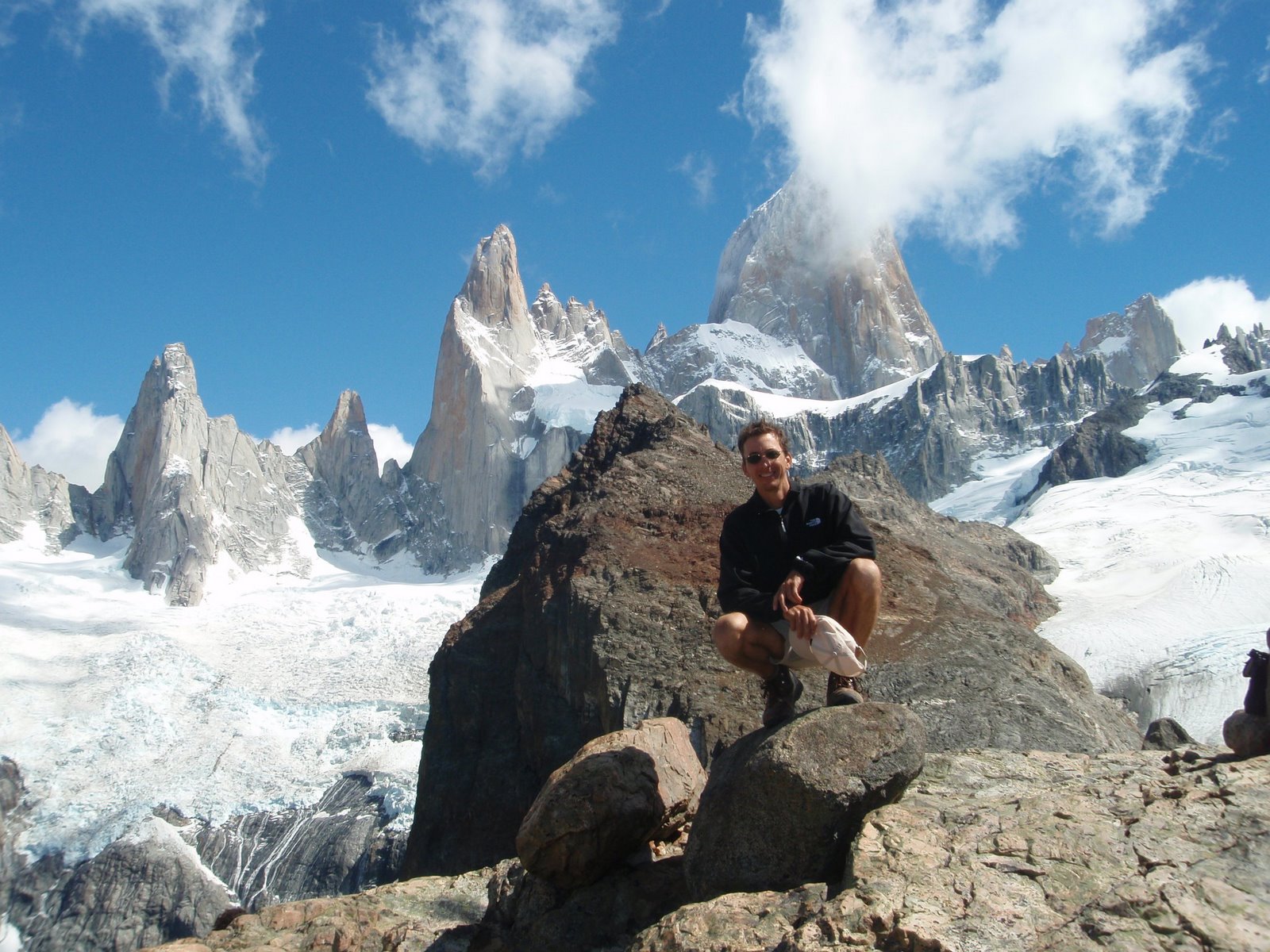
Since I've pretty much thrown out the idea of going to Tibet I've decided to experience as much of the Tibetan culture as I can within the Yunnan and Sichuan provinces. My plan now is to take a bus to Dequin and trek around the 6,740 meter Mt. Kawa Karpo. The scenery is supposed to be amazing with glaciers, waterfalls, and airy peaks. High, wild, and off the tourist track. I'll likely see a few more adventurous backpackers but don't expect to see many. The road to Dequin tops 5000 meters 3 times on the way from Shangrila. I plan to spend a few days trekking around Dequin then I'll return to Shangrila. I'll then head to Litang. From Litang I'll likely go to Ganzi and inquiry about the possibility of crossing into the Qinghai province via a high route close to the Tibetan boarder. The travel should be very interesting with local buses and questionable facilities. I'm not sure how internet access will be but I'll post when I can.

So, tomorrow I'll board a bus at 8:20 am. From what I can tell it will take anywhere from 6 to 10 hours to get the Dequin. Apparently there's road construction along the way.


May 1, 2011

Caught Up In The Journey - Destination?


I’ve been close to a month on the road and as always time is passing very quickly. Travel has been much easier than anticipated and in all honesty not quite as exiciting as I thought it would be. I’ve had some great days but for the most part it’s been pretty much a ho hum experience. I’ve been to enough places in the world that my definition of exotic foreign travel has evolved and changed. For someone who has never traveled outside of the west, China would probably be kind of a mind blower. For me, it’s Asia as I’d more or less expect. What’s nice about it is that I’m very comfortable traveling here. At I times I find myself in a more contemplative state of mind.


Words get in the way of communication and plans can get in the way of life. Be open to all you see. It’s impossible not to have an opinion but try not to judge. Although people and cultures can be so different everyone has the same to desire to live a peaceful happy life amidst family and friends. Day to day existence is survival for everyone. Some pick up a hoe and walk to the fields while others pick up a laptop and drive a BMW to work. The end goal is the more or less the same for everyone. Some are more concerned with the health of their portfolio, others the health of their Yak. Me? I live in the in-between, circumnavigating the contrasts of existence and my role amidst it all.


I guess you can say I’m compelled to stockpile a mixed load of life experiences. In a interesting and exciting way I feel it’s all leading me somewhere. Somedays I question what am I really doing? Why do I feel this drive? At the same time I feel like I’m right where I’m supposed to be so I just trust the feeling and do my best to stay present in the now. Caught up in the Journey but not really sure of the destination.

A Place Called Shangrila & Tibet Not Likely


I’m now in Shangrila. It’s an old city that changed it’s name to attract tourist to a 10,000+ ft. rarified air environment full of Tibeten culture. Yeah, it’s touristy but not too bad and it still retains a certain kind of charm. It reminds me a lot more of the American west than some idylic mythical Shangrila. The area consists of a broad filled valley surrounded by hills and distant mountains under a crystal clear blue sky. The nights are cold, the air is dry, and the days are just right. Tibeten temples, stupas, and prayer flags decorate the surrounding area. The people are low key, nice, and the Tibetens always seem to be smiling.

I was hoping to make arrangements to travel into Tibet from here but China is not making it easy. It now takes 10 days to acquire a permit and unless I want to fly. I’ll have to depart out of Chengdu if I want to go overland. The travel agencies here are saying I will also be required to hire a guide at around 1,000 rmb a day which is outrageous when I know I could hire a guide on my own for about a 100 rmb day. Supposedly everything has to be set up through an agency beforehand. Tibet is looking unlikely. Too expensive and too much hassle. As of now I’ll pass through Chengdu anyway so I’ll check the situation there. However, 10 days to get a permit really makes planning inconvenient. For one, I don’t want a guide and I generally don’t like to plan too much beforehand. Plans have a way of getting in the way. Apparently foreigners are not allowed to travel anywhere in Tibet wihtout a guide. My only real chance now would be to stumble into a group of backpackers trying to put something together out of Chengdu.

My curretnl plan is to travel western Sichuan, off the tourist track, on local busses to some high villages. Some above 13,000 ft where real Tibetan culture can be found. I really like the gentle nature of the Tibetan people as there is a lot of Tibetan culture where I am right now. Not to mention the Yak yogurt and Yak meat is amazing. A Tibetan man told me last night that Yak meat is very powerful and I have to agree. In this part of the world I’m sure it’s all range feed, all natural, and quite healthy.

Tiger Leaping Gorge


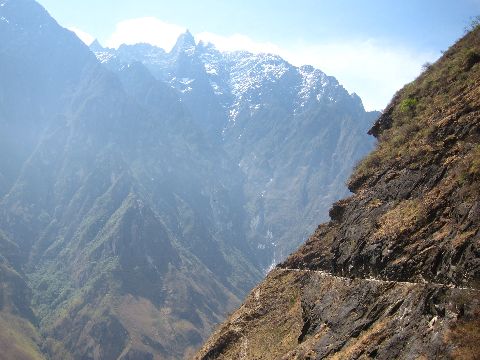
Tiger Leaping Gorge was a welcome relief from the busy cities and Chinese tourist destinations that I’ve been passing through. It's a canyon gorge formed by a river that passes between 5,596 meter Jade Dragon Snow Mountain and 5,396 meter Haba Xueshan. There’s a nice 2 day trek up along a high route above the river.

It appears to be relatively popular with westerners but not Chinese. The Chinese prefer a bus tour to a particular point along the river with a short day walk to glimpse a view of the steep cliffs that rise above the valley. The High Route avoids the circus below and can only be traveled by foot or horse. Along the way you pass through some villages that offer basic but good accomodation and decent food. I spent two nights in the Gorge but kind of wish I had spent a couple of more as there are other hikes aside of the High Route.

The short trek really reminded me how much I like hiking and walking. Right now I think that’s mostly what I’d like to be doing. However, hiking is not well developed in China, good maps are impossible to find, and information dubios. Nonetheless, I do seem to stumble upon some pretty good day walks everywhere I go but there’s nothing like shouldering a pack and heading off for a week, month, or more traversing long distances with everything you need on your back.

As for Tiger Leaping Gorge I’ll let the pictures do the talking…….